Introduction
Imagine your university has just admitted its first blind student, or your company needs accessible documents for the first time. You search online and quickly discover that there are several braille transcription companies to choose from.
How do you know which company is the right fit for your project?
Price matters, but it shouldn’t be the only factor in your decision. Experience, communication, reliability, and the ability to meet your specific needs are just as important. Asking the right questions before you begin can help you choose a braille partner with confidence.
Here are five questions worth asking before selecting a braille transcription company.
1. Have you completed projects like mine before?
It’s an excellent place to start.
Many outstanding braille transcribers develop deep expertise in a particular area, such as Nemeth mathematics, music braille, foreign languages, tactile graphics, maps, or literary transcription. That’s one of the great strengths of our profession.
However, it’s equally important to ask how your specific project will be assigned and managed.
At Braille and More, we’ve intentionally built a network of specialists so we can match each project with the experience it requires. Whether your materials involve education, mathematics, music, tactile graphics, business documents, or something else entirely, we assign the professionals best suited for the job.
Just as important, we’ve spent years building relationships with transcribers who have earned our confidence. Technical braille skills are only part of what makes an exceptional transcriber. Reliability, communication, attention to detail, professionalism, and the ability to consistently meet expectations are equally important. The specialists on our team have demonstrated those qualities through successful projects and proven performance over time.
Rather than expecting one person to excel in every specialty, we assemble the right expertise for each client’s unique needs.
2. How much advance notice do you need, and will you be able to meet my deadlines?
Meeting deadlines is one of the most important factors when choosing a braille transcription company. Whether you’re preparing for the first day of school, a university semester, a business event, or an important presentation, your braille materials need to arrive when they’re needed—not afterward.
Every braille provider has a different workload and scheduling process. Some projects can begin immediately, while others require additional lead time depending on their complexity and the company’s current commitments. That’s why it’s important to ask not only whether a deadline can be met, but also how much advance notice is recommended for projects like yours.
At Braille and More, we’ll always be honest about what is realistically achievable. If we can meet your deadline, we’ll commit to it. If a project is unusually large or the timeline is especially tight, we’ll discuss your options right away.
In educational settings, one of the best ways to stay ahead is to receive a course syllabus as early as possible. That allows us to plan production before weekly assignments begin. For other types of projects, early communication gives us the opportunity to schedule production efficiently and help ensure your braille materials arrive when they’re needed.
Because we’ve built a network of trusted specialists, we’re often able to assign additional resources when appropriate to help keep projects on schedule. Our goal is simple: deliver high-quality braille when you need it.
3. Can you deliver BRF files, embossed braille, or both?
Your needs may change from one project to the next. Perhaps your organization owns a braille embosser and has staff who can produce braille in-house. That may work well for straightforward text documents. However, projects that include tactile graphics, multiple volumes, or collated materials often require additional equipment, expertise, and time.
In other situations, your staff may simply be juggling too many responsibilities to handle braille production internally. Having the flexibility to receive either digital BRF files or fully embossed and bound braille can make it much easier to meet your accessibility goals.
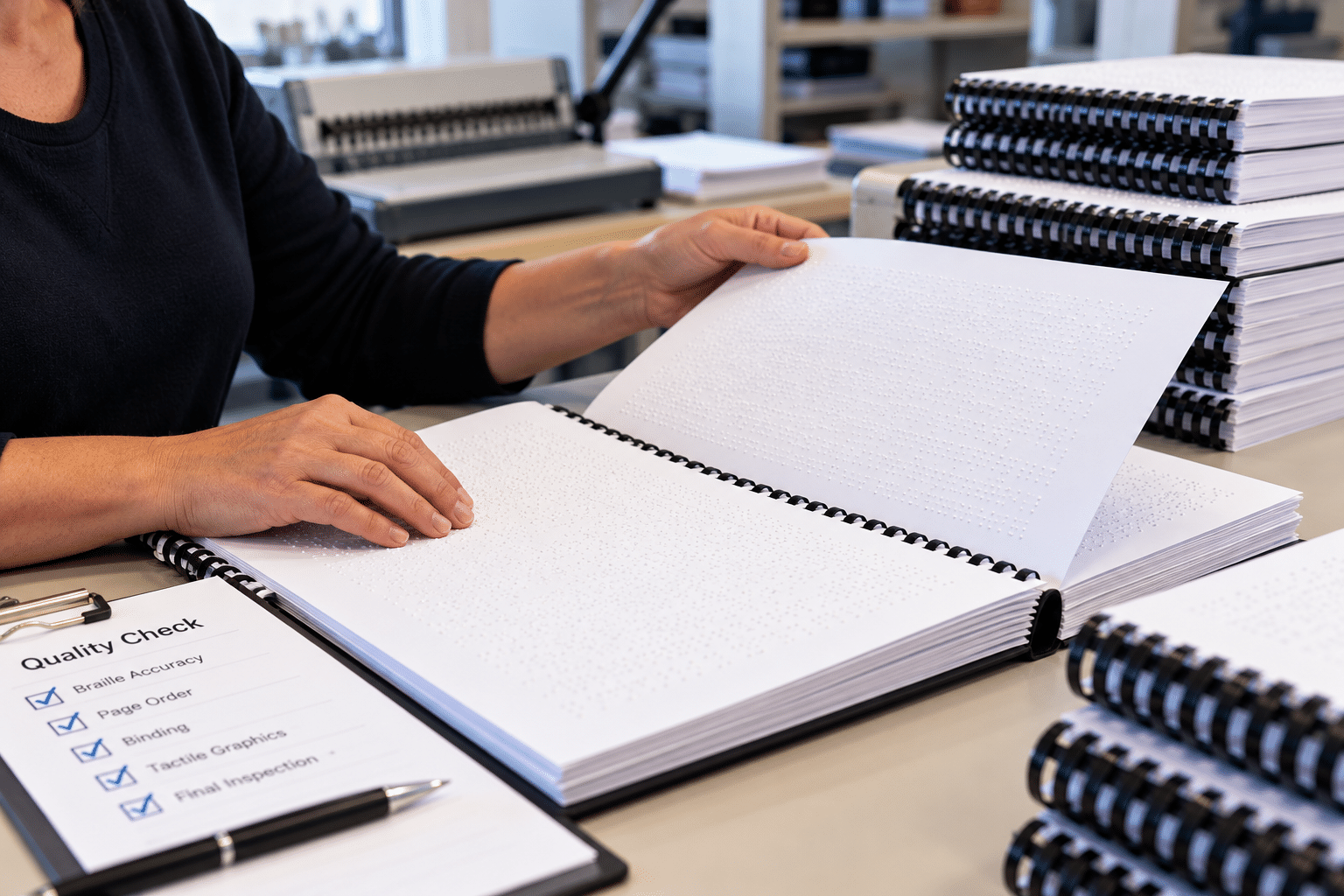
Once you’ve determined which format best meets your needs, don’t hesitate to communicate your production preferences. Some organizations have detailed specifications covering everything from tactile graphics and title pages to spine labels, packing slips, shipping methods, and project completion reports. Sharing those expectations at the beginning of the project helps ensure everyone is working toward the same goal while minimizing misunderstandings.
When evaluating a braille provider, ask what delivery options are available. Some companies specialize in digital files, while others can also produce finished braille ready to distribute. Understanding those capabilities up front can save time, simplify the production process, and prevent surprises later.
4. How do you handle complex or specialized projects?
Not every braille project is a simple document. You may need an entire chemistry course transcribed, complete with textbooks, classroom handouts, quizzes, exams, PowerPoint presentations, and complex tactile graphics. Or perhaps your project involves advanced mathematics, foreign languages, music notation, or other highly technical material.
Even if your current project is relatively straightforward, it’s worth asking how a braille provider handles more complex work. Their answer can tell you a great deal about their experience, capabilities, and ability to grow with your organization’s future needs.
In today’s world of virtual meetings, consider asking for a brief video call when evaluating a new braille provider. A conversation can tell you a great deal about a company’s knowledge, professionalism, communication style, and confidence. Sometimes you’ll learn more in a 20-minute conversation than through days of email exchanges.
Don’t be afraid to ask questions such as:
- Have you completed projects like this before?
- Who would be assigned to the project?
- How are tactile graphics handled?
- If multiple specialists are involved, how do you ensure consistency throughout the finished product?
The answers should leave you feeling confident that the provider has both the expertise and the processes in place to successfully complete your project—no matter how simple or complex it may be.
5. Can you support my future braille needs as they grow?
Your first project may be relatively small—perhaps a visually impaired freshman enrolls at your college, or a business needs a single document translated into braille. But what happens if that relationship grows? Can your braille provider grow with you?
When evaluating a provider, consider not only your immediate needs but also where your organization may be a few years from now. Will they be able to support larger, more specialized projects? Can they adapt if your accessibility needs become more complex or the number of braille readers you serve continues to grow?
At Braille and More, we’ve had the privilege of growing alongside many of our clients.
One university first contacted us to produce music braille for a single student pursuing a music minor. After seeing the quality of our work and the professionalism of our team, they returned when another student enrolled in a Doctor of Pharmacy program. That relationship grew into a five-year contract involving some of the most technically challenging textbooks, tactile graphics, and instructional materials our team has ever produced.
We’ve experienced that same kind of long-term partnership on a personal level as well.
In 2018, our founder, Patrick Janson, first transcribed simple choir music for a high school student. At her request, he continued producing braille throughout her collegiate music studies, including textbooks, exams, and musical scores. Today, Braille and More still produces braille for her career as a middle school music teacher.
The best client relationships are built over time. Finding a braille provider who can meet your needs today—and continue supporting you as those needs evolve—can save time, build trust, and create a true long-term partnership.
Final Thoughts
Choosing a braille transcription company isn’t simply about finding the lowest price. It’s about selecting a partner who understands that every braille project represents a real person—someone who depends on those materials for education, employment, independence, or enjoyment.
By asking these five questions, you’ll gain a better understanding of a company’s experience, communication, capabilities, and commitment to quality. The answers should give you confidence that your project will be completed accurately, delivered on time, and handled with the care it deserves.
At Braille and More, we’ve built our company around those same principles. We believe every project deserves the right specialist, clear communication, dependable service, and a commitment to producing braille that our clients—and the people who read it—can trust.
Whether you’re preparing your first braille project or looking for a long-term accessibility partner, we’d welcome the opportunity to help. If you have questions about your project, we’re always happy to discuss your options and help you determine the best path forward.
Whether you’re just getting started or managing a complex accessibility project, we’re happy to answer your questions and help you determine the best solution.
✓ Schools & K–12
✓ Colleges & Universities
✓ Businesses & Organizations
✓ Individuals & Families